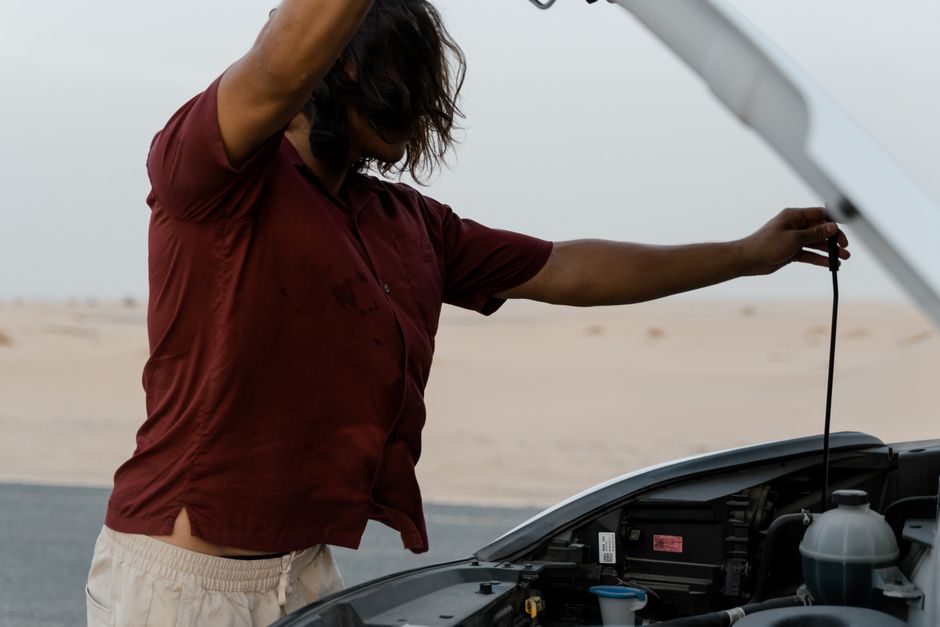
When the temperature climbs only at a stoplight
Car overheating at idle is one of those problems that feels backwards. The engine is fine while you’re moving, then the gauge starts creeping up the moment traffic slows or you park and let it run. That pattern matters, because it usually points away from the engine itself and toward the parts that depend on airflow, coolant circulation, or fan operation. In other words, the car is often telling you, very specifically, that it can’t shed heat when the vehicle is no longer moving.
That distinction helps narrow the problem fast. A car that overheats only at idle is usually not suffering the same type of failure as one that overheats on the highway. At speed, ram air through the radiator does a lot of the cooling work. At idle, the electric fan or fan clutch has to take over, and the cooling system has to move coolant cleanly through the engine, radiator, thermostat, and hoses. If any one of those links is weak, the temperature rises first in traffic, not on the open road.
The parts most likely to be involved
When I see this symptom, I mentally work through a short list before I start guessing. The usual suspects are the radiator fan, fan relay or fuse, coolant level, thermostat, radiator cap, water pump, and airflow blockage at the condenser or radiator. Less often, the problem is a slipping belt, a clogged radiator, or an air pocket trapped in the system after a coolant service. The trick is not to replace parts at random. The symptom already gives you a map.
1. Cooling fan problems
If the fan does not come on when the engine gets hot, the car can run fine while moving and then overheat as soon as it sits still. That is the classic idle-overheat pattern. On many modern cars, the fan is electric and controlled by a relay, a fuse, a temperature sensor, or the engine computer. On some older vehicles, a mechanical fan clutch handles the job. Either way, the fan’s purpose is simple: pull air through the radiator when road speed is too low to do it naturally.
A fan issue is not always obvious. Sometimes the fan works only on one speed. Sometimes it runs, but weakly. Sometimes the relay is intermittent, so the fan behaves until the engine bay gets hot enough to expose the fault. A quick real-world check is to let the engine warm up while parked and watch whether the fan cycles on before the temperature gets uncomfortably high. If it never starts, or starts too late, the problem may be electrical rather than mechanical.
2. Low coolant or trapped air
Low coolant can absolutely cause overheating at idle, especially if the level is just low enough that circulation becomes inconsistent. The system may still look “full enough” when cold, but once the engine warms up, the coolant expands, shifts, and leaves a weak spot in the loop. Air pockets are even more annoying because they can block flow through the thermostat or heater core and make the temperature gauge behave erratically.
After a coolant drain, hose replacement, thermostat job, or radiator repair, a car may need proper bleeding. Many people refill the reservoir and assume the job is done. It often is not. If air remains trapped, the engine can overheat at idle even though the coolant level appears normal. That is why a correct fill procedure matters more than just pouring in more coolant.
3. Thermostat sticking closed or opening slowly
The thermostat is a temperature-controlled valve, and when it sticks, coolant flow suffers. A thermostat that opens slowly can create a pattern where the engine seems okay at first, then climbs too high when heat builds and airflow drops. This is especially noticeable in stop-and-go traffic. A bad thermostat does not always fail dramatically; sometimes it just becomes lazy.
People often assume a thermostat is either “good” or “bad,” but the in-between failures are common. The car may warm up too slowly, run hotter than normal under load, or oscillate around the upper end of the gauge. If the upper radiator hose stays cool much longer than expected, that can be a clue that coolant is not circulating properly through the radiator.
4. Radiator restriction or poor heat transfer
A radiator can be partially clogged internally or packed with debris externally. Both problems reduce its ability to dump heat. External blockage is easy to overlook because the front of the radiator may look fine from a distance, while the fins are loaded with dirt, bugs, leaves, or bent sections that block airflow. Internal restriction is harder to see and often shows up as uneven temperature across the radiator surface.
This is where the symptom at idle becomes useful again. At highway speed, a marginal radiator may still manage because airflow is strong. At idle, that weakness shows up immediately. If the car only overheats when stationary, the radiator may be borderline rather than completely failed. That is why “it still drives okay” is not a reliable sign that the cooling system is healthy.
5. Water pump or belt issues
The water pump keeps coolant moving. If the impeller is damaged, the pump is leaking, or the belt driving it is slipping, circulation drops. Some pumps fail gradually, so the engine may only overheat under conditions where cooling demand is highest and flow is weakest — like idling on a hot day with the air conditioning on.
Not every water pump failure announces itself with a dramatic leak. Sometimes the bearing gets noisy, the pulley wobbles, or the pump simply loses efficiency. A loose or glazed belt can create a similar effect on belt-driven systems. If the pump is not moving coolant as intended, the radiator and fan can be doing their job and the engine still runs too hot.
Why idle is the hardest test for a cooling system
At idle, the engine is still making heat, but the cooling system loses one of its biggest helpers: vehicle speed. That means the fan must compensate, and coolant flow must stay consistent even when engine rpm is low. Air conditioning makes the job harder because the condenser adds heat in front of the radiator. So if the car overheats only when stopped with the A/C on, the system may be right on the edge of its capacity.
This is why the same car can feel perfectly normal on the freeway and still boil over in a parking lot. It is not being “weird”; it is exposing a margin problem. A cooling system with a weak fan, a slightly restricted radiator, or a thermostat that opens late may survive at speed and fail at idle because idle is the lowest-cooling, highest-stress scenario for heat rejection.
A practical diagnosis order that saves time
If you are trying to figure out the cause without wasting money, start with the checks that cost almost nothing and eliminate the most common failures first. The order matters because a lot of people jump straight to the thermostat or water pump when the real issue is a fan fuse or a low coolant level. That kind of guesswork gets expensive fast.
- Check coolant level when the engine is cold. Look at both the radiator and the reservoir if the design allows it. A low radiator with a full reservoir is a red flag.
- Watch the fan. Let the engine warm up at idle and see whether the fan starts when the temperature rises.
- Inspect the front of the radiator. Dirt, bent fins, plastic bags, or leaves can choke airflow.
- Look for leaks. Wet hose ends, crusty residue, coolant smell, or dried deposits around the radiator and water pump matter.
- Check heater performance. Weak cabin heat can hint at low coolant or trapped air.
- Observe hose temperature behavior. A hose that stays cool too long can suggest thermostat or circulation issues.
That sequence will not solve every case, but it will separate the obvious from the expensive. And in cooling-system work, that is half the battle.
What the dashboard gauge is trying to tell you
Drivers sometimes wait until the gauge is deep in the red before taking action, but the early movement of the needle is the useful part. A slow climb at idle often means the cooling system is losing control gradually, not catastrophically. That can be a fan that is cycling too late, a thermostat that is sluggish, or a radiator that has lost efficiency over time. A sudden jump, on the other hand, is more consistent with a major circulation problem, a large coolant loss, or an air pocket.
Some vehicles have very damped gauges that stay in the middle for a long time and then move quickly once the problem is already serious. If you drive one of those, do not trust the needle alone. Pay attention to warning lights, smell, steam, or the fan running constantly. By the time a modern dashboard finally admits there is a problem, the engine may already be running hotter than is healthy.
Common mistakes people make when the car overheats at idle
The first mistake is adding coolant without finding out where it went. Coolant does not disappear for fun. If the level is low, there is usually a leak, a bad cap, or a system that was not bled correctly. The second mistake is replacing the thermostat as a reflex without checking fan operation. The third is assuming a fan that spins means a fan that works correctly. Speed, control, and timing matter just as much as motion.
Another common mistake is testing the car only once, in mild weather, and calling it fixed. Some overheating problems show up only with the A/C on, after a long drive, or on a hot afternoon. A cooling system should be tested under the same conditions that trigger the complaint. Otherwise, the problem will wait politely until you are back in traffic.
When it is safe to keep driving and when it is not
If the temperature rises slightly at idle but drops back down as soon as the car starts moving, you may have enough margin to nurse the car home or to a shop. But if the gauge keeps climbing, the warning light comes on, steam appears, or the heater suddenly blows cold while the engine is hot, stop driving. Overheating can warp a cylinder head, damage the head gasket, and turn a manageable repair into a major one.
There is also a practical rule here: never open a hot cooling system cap unless you absolutely know what you are doing and have let the engine cool enough. Pressurized coolant can cause serious burns. The urge to “just check the level quickly” has ruined more than one afternoon and more than one hand.
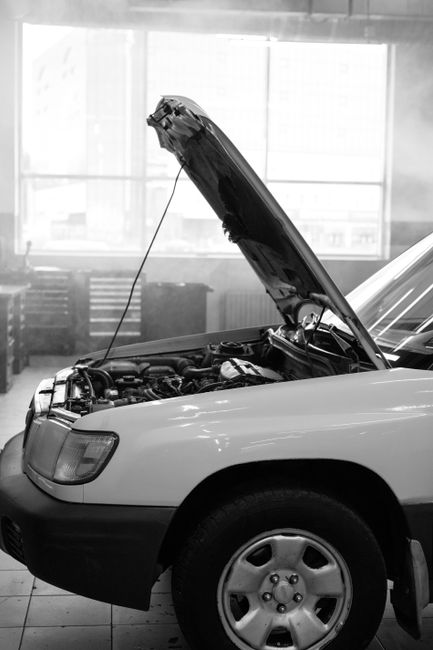
What a proper repair usually looks like
The right fix depends on the diagnosis, but the repair should match the failure, not the symptom. If the fan relay is bad, replace the relay and verify fan operation. If the system is low on coolant, find the leak and repair it before refilling. If the thermostat is sticking, replace it and bleed the system correctly. If the radiator is clogged, cleaning may help when the blockage is external, but internal restriction usually means replacement is the real answer.
For cars that repeatedly overheat at idle after multiple repairs, the problem may be more than one weak link. I have seen vehicles where a marginal fan plus a slightly clogged radiator created a complaint that no single part replacement fully solved. That is why a cooling system should be treated as a whole. Every component has to do its share, or the weakest one sets the limit.
How to prevent it from coming back
The easiest prevention is basic maintenance done on time and done correctly. Use the right coolant type for the vehicle, keep the system filled properly, inspect hoses and belts before they fail, and do not ignore a fan that sounds weaker than usual or cycles strangely. If the car has been serviced recently, make sure the system was bled and tested after refill. A lot of idle-overheat complaints begin right after a cooling system job that left air trapped inside.
It also helps to pay attention to small changes. A car that used to idle at a steady temperature and now creeps upward in traffic is not being “a little different.” That is usually the first stage of a problem that will get worse. Catching it early is cheaper than waiting for a roadside boil-over.
The short version
Car overheating at idle usually means the cooling system is fine enough at speed but struggling when airflow drops. Start with the fan, coolant level, and air bleeding, then move to the thermostat, radiator, water pump, and belt drive if needed. The pattern itself is the clue: if the car only gets hot when it stops moving, the fix is often in the parts that help the engine cool without road speed.
That is why the best diagnosis is not a guess. It is a sequence. Check the simple things first, watch what the fan does, and treat the system as a connected loop instead of a pile of parts. That approach saves money, saves time, and usually prevents the kind of damage that starts with a hot gauge and ends with a very expensive repair bill.

Comments (0)
No comments yet. Be the first to comment!
Leave a Comment