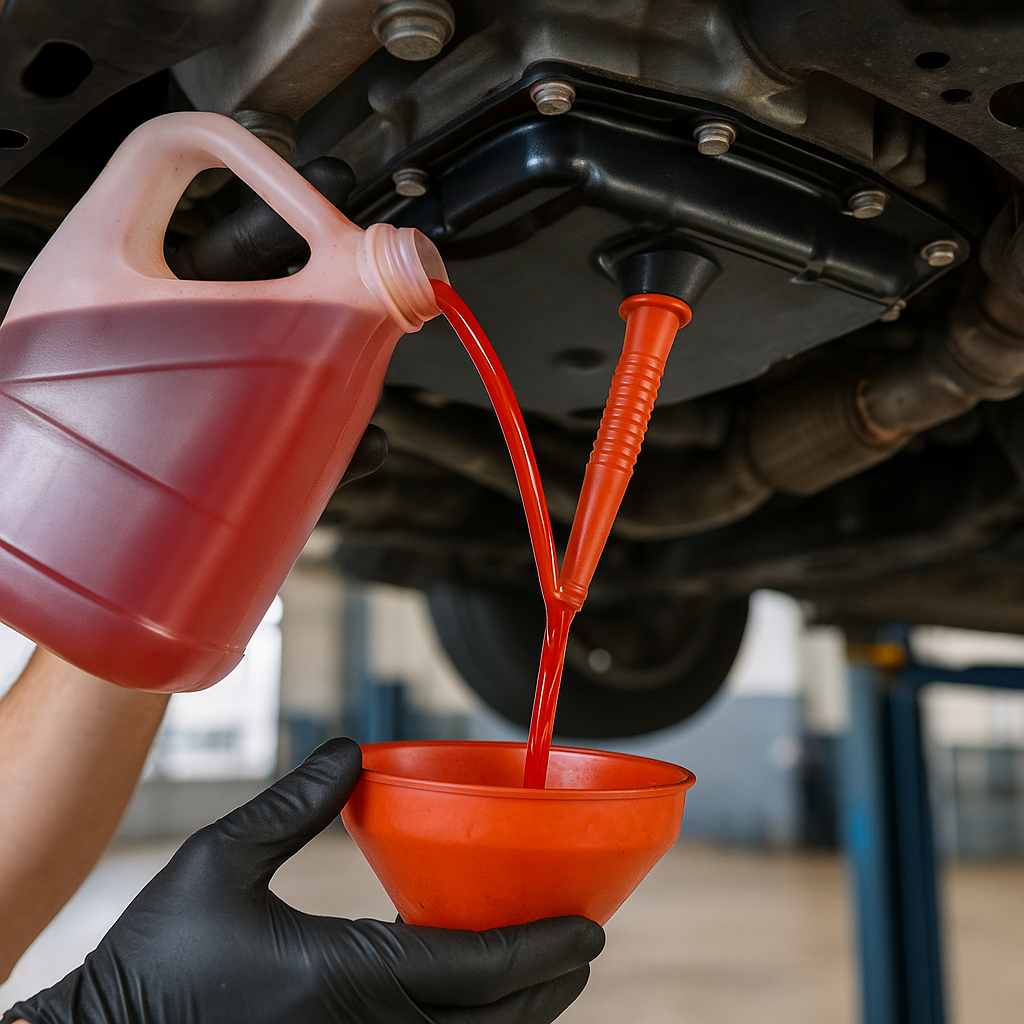
How often should you change transmission fluid, really?
The honest answer is that there is no single mileage number that fits every car. The right interval depends on the transmission design, the fluid type, the vehicle’s workload, and how heat is managed. A commuter sedan that spends its life on smooth highways can go much longer than a pickup that tows, idles in traffic, and climbs hills every day. That difference matters because transmission fluid is not just lubricant; it is also a hydraulic medium, a cooling agent, and in many automatic transmissions, part of the friction-control system that makes shifts feel smooth.
Most owners get into trouble by treating transmission service like an oil-change sticker. They wait for a number on a schedule, then either service too early and waste money or wait too long and start seeing harsh shifts, delayed engagement, or shudder. The better approach is to read the service schedule as a starting point, then adjust for how the vehicle is actually used.
What the fluid is doing inside the transmission
Transmission fluid has a harder job than most people realize. Inside an automatic transmission, it has to keep hydraulic pressure stable, reduce wear on gears and clutches, transfer heat away from internal parts, and maintain the friction characteristics that the transmission was engineered around. In a manual transmission, the fluid still protects gears and bearings, but the demands are different and usually less heat-intensive. In a CVT or dual-clutch transmission, the fluid formulation can be even more specialized, which is why using the wrong product can cause problems quickly.
As fluid ages, it breaks down from heat and contamination. Heat is the main enemy. Repeated high-temperature operation changes the fluid’s chemistry, and wear material from clutches, gears, and seals gradually accumulates. The result is not always a dramatic failure. More often, the transmission slowly starts to feel less precise: shifts become less crisp, engagement takes longer, and the unit may run hotter than it should.
The interval depends on the transmission type
Automatic transmissions
For many conventional automatics, a common service range is somewhere around 30,000 to 60,000 miles for severe use, with longer intervals possible under lighter use if the manufacturer allows it. Some newer vehicles advertise longer intervals or even “lifetime” fluid, but that phrase is best treated carefully. “Lifetime” often means the expected warranty or ownership period under ideal conditions, not a promise that the fluid will remain fresh forever.
If you drive mostly in stop-and-go traffic, tow, carry heavy loads, or live in a hot climate, the fluid ages faster. Those conditions generate more heat and more clutch wear. A vehicle that sees those conditions regularly should generally be serviced sooner than one used mainly for highway commuting.
Manual transmissions
Manual gearboxes usually need fluid changes less often than automatics, but they are not maintenance-free. Many owners ignore them because the transmission still shifts, yet old fluid can make synchros feel lazy and can increase wear over time. Depending on the vehicle, the interval can be much longer than for an automatic, but checking the factory schedule matters because some manuals use gear oil, while others require a specific fluid with different friction properties.
CVTs and dual-clutch transmissions
Continuously variable transmissions and dual-clutch units are more sensitive to fluid condition and fluid specification than many traditional automatics. Their service intervals are often shorter or more tightly defined by the manufacturer. These transmissions can be expensive to repair, so following the exact fluid type and service interval is more important than trying to stretch maintenance. If the owner’s manual calls for a specific CVT or DCT fluid, that is not a place to improvise.
Why the owner’s manual matters more than internet averages
Generic advice can be useful as a rough benchmark, but the factory maintenance schedule is the only source that accounts for the transmission’s design, the vehicle’s cooling system, and the fluid specification. Some vehicles have a normal-service interval and a severe-service interval; others separate the schedule by driving conditions. If the manual gives both, the severe-service interval is the one most owners should compare against honestly. Many drivers think their use is “normal” when it actually includes short trips, heavy traffic, mountain driving, or towing.
One practical mistake is assuming that a newer car automatically needs less maintenance. Modern transmissions often hold up well, but they are also more complex and more dependent on the right fluid chemistry. Better engineering does not eliminate the effects of heat and contamination. It only means the system can tolerate them longer before symptoms become obvious.
Signs the fluid is overdue
Waiting for a warning light is not a good strategy. Transmission fluid can be badly degraded long before the dashboard complains. A few signs are worth paying attention to:
- Delayed engagement when shifting from Park to Drive or Reverse
- Harsh, flare-like, or hesitant shifts
- Shudder during acceleration or gear changes
- Dark, burnt-smelling fluid
- Leaking red or amber fluid under the vehicle
- Transmission running hotter than usual, if the vehicle shows temperature data
None of these symptoms automatically means the transmission is failing, but they do mean the fluid should be inspected quickly. Burnt smell is especially important. Fresh fluid has a clean, slightly oily smell. Once it smells scorched, the fluid has likely spent too much time at high temperature.
How to inspect fluid without guessing
Some vehicles still have a dipstick for transmission fluid, but many newer models do not. That does not mean inspection is impossible; it usually means the check is done through a fill plug, overflow plug, or service procedure that requires the vehicle to be level and the fluid at a specific temperature. This is one reason many owners prefer a professional service, especially on sealed transmissions.
If your vehicle does have a dipstick, check the level and appearance on level ground and follow the manufacturer’s instructions exactly. Fluid color alone is not enough to judge condition, but it does help. Healthy fluid is typically red, amber, or light brown depending on age and design. Very dark fluid, visible debris, or a burnt odor are warning signs. Low fluid is just as serious as old fluid, because even a small loss can affect hydraulic pressure and shift quality.
Drain-and-fill versus flush: what usually makes sense
Owners often hear conflicting advice about flushing. The practical distinction is simple: a drain-and-fill replaces part of the old fluid, while a flush attempts to exchange most or all of it through the system. A drain-and-fill is usually the more conservative choice, especially for higher-mileage transmissions with unknown service history. It is less aggressive and less likely to disturb deposits that have been sitting undisturbed for years.
A flush can be appropriate when the transmission is healthy, the fluid type is correct, and the service is done by someone who understands the unit. The problem is not the concept itself; the problem is poor execution or using the wrong fluid. On some transmissions, especially those with specific service procedures, a careful drain-and-fill repeated over time is a safer maintenance strategy than a single high-pressure flush.
If the fluid has never been changed and the vehicle has high mileage, a cautious approach is usually better than a dramatic one. In that situation, a technician who understands the transmission can inspect the fluid, note any debris, and decide whether a partial service is wiser than a full exchange.
How driving habits change the service interval
Two vehicles with the same odometer reading can have very different transmission-fluid needs. The one that spends its life on the highway usually sees less heat cycling than the one used for short errands. Short trips are hard on fluid because the transmission may never reach and stabilize at ideal operating temperature before the car is shut off again. Heat buildup and condensation are both more likely over time.
Towing is another major factor. Even when the engine feels fine, the transmission may be working much harder than usual. The same is true for steep grades, heavy cargo, aggressive acceleration, and frequent stop-and-go driving. If any of those describe your use pattern, shorten the interval rather than stretching it.
Climate matters too. Hot weather increases thermal stress, and cold weather can make old fluid feel sluggish until it warms up. Neither condition is automatically damaging on its own, but both can expose fluid that is already near the end of its service life.
What happens if you wait too long
Old transmission fluid does not usually cause an immediate failure. It causes a slow decline that owners often adapt to without realizing it. Shifts become slightly slower, the transmission may hunt between gears, and heat management gets worse. Those changes can accelerate wear on clutches, seals, valve bodies, and solenoids. Once wear reaches that stage, a fluid change may improve behavior, but it will not reverse mechanical damage that has already happened.
The expensive part is that transmission problems are often cumulative. A unit that has been running hot for a long time may not fail all at once. It may simply become more sensitive to load, more likely to slip, and more expensive to diagnose. Regular fluid service is cheap insurance compared with rebuilding or replacing a transmission.
A practical rule you can actually use
If you want a simple decision rule instead of a vague answer, use this: follow the factory schedule first, then move to the shorter end of the interval if your driving is severe, your vehicle tows, or the transmission runs hot. If the manual is unclear, a conservative maintenance mindset is better than waiting for symptoms.
- Light use, mostly highway, no towing: use the manufacturer’s normal-service interval
- Mixed use with traffic, short trips, or warm climate: lean toward the shorter end of the recommended range
- Towing, heavy loads, mountains, or frequent stop-and-go: treat the vehicle as severe-service
- Unknown service history: inspect first, then service conservatively
That approach is more reliable than chasing a universal mileage number. It also helps you avoid the common mistake of overextending fluid life simply because the transmission still feels “okay.”

Choosing the right fluid matters as much as timing
Transmission fluid is not interchangeable. The wrong specification can change shift feel, clutch behavior, seal compatibility, and temperature stability. That is especially true for CVTs, dual-clutch transmissions, and some modern automatics. Using a fluid that merely “fits” the vehicle by container label is not enough. The exact specification in the owner’s manual or service information is the one that matters.
When in doubt, match the factory spec rather than the marketing language on the bottle. If a shop cannot clearly explain which fluid they plan to use and why it matches your transmission, that is a warning sign. A correct service with the wrong fluid can create more problems than an overdue service with the right one.
The bottom line for most drivers
For many cars, transmission fluid should not be treated as a once-in-the-lifetime fluid. The safest answer to how often should you change transmission fluid is: as often as your owner’s manual recommends, and sooner if your driving is hard on the transmission. That usually means paying close attention to heat, towing, traffic, and fluid specification rather than relying on a single universal mileage figure.
If you are unsure where your vehicle falls, check the manual, look at the service history, and inspect the fluid condition before making a decision. A well-timed fluid change is one of the simplest ways to protect a transmission that still shifts properly. Waiting until the symptoms are obvious is usually the expensive path.

Comments (0)
No comments yet. Be the first to comment!
Leave a Comment